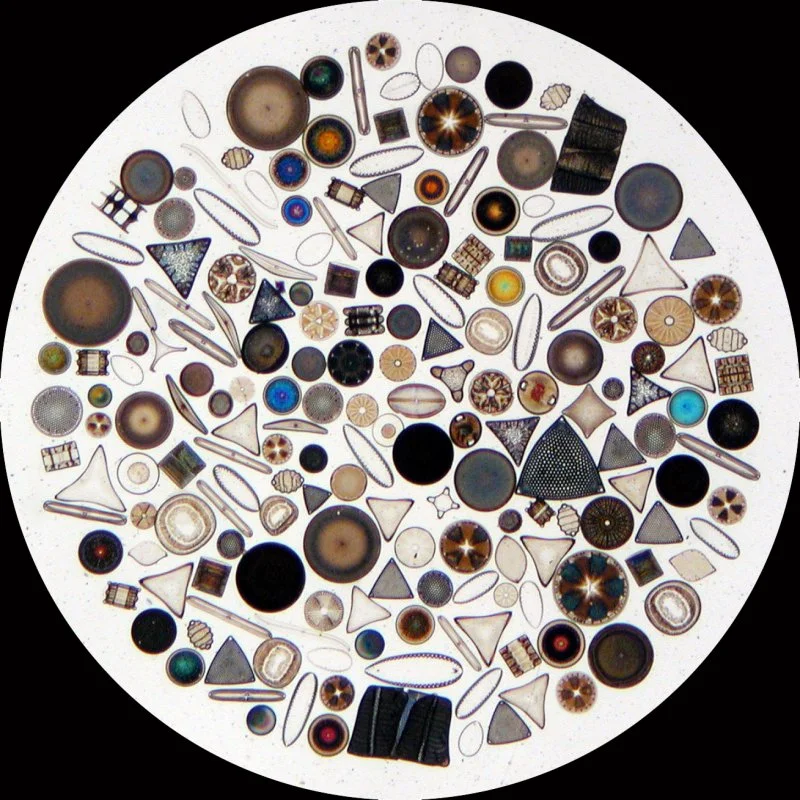
Diatoms (Wipeter, Wikimedia Commons)
Sonic Silica is a generative sound engine that speculates on the invisible ecologies of diatoms inhabiting the brackish waters of the Ebro Delta, one of Europe's most important wetlands and a UNESCO Biosphere Reserve, now at imminent risk of ecological collapse.
Drawing on data collected by IRTA in the Fangar and Alfacs bays (PHYTOENVDELTA dataset, 1990–2019), as well as climatological (AEMET, SMC) and physicochemical (Copernicus) data, the work constructs a reactive sonic ecosystem that models the lives of the dominant diatom species inhabiting these bays in the near future. The system emulates the delta's transient and ever-changing nature, understanding diatoms not merely as microscopic organisms but as agents within a complex choreography shaped by human activity, climatic instability, and post-Anthropocene futures.
Sonic Silica draws inspiration from cellular automata, Curtis Roads' ideas developed in Microsound, and David Kanaga's generative audio practices for videogames (Proteus, Dyad, Panoramical). Its timbres, shaped through processes such as resynthesis, evoke the silica dioxide frustules (glass-like structures) of diatoms, articulating a constantly recombining sonic landscape derived from the environmental conditions described above.
The sound engine behind Sonic Silica was originally developed in Unity and FMOD before being ported to HTML5 and, ultimately, to Python + Ableton Live, the implementation that provides the greatest flexibility and complexity while enabling playback through a multichannel sound system.
The project has been developed with the guidance of Rosa Trobajo, Margarita Fernández Tejedor, and David Mann, and forms part of Mapping The Invisible, a collaborative project created together with Lauren Moffatt and Jaume Vidal for the European project COVISION, with the support of the Eufònic Festival.
Links: Eufònic 2024, Eufònic 2025
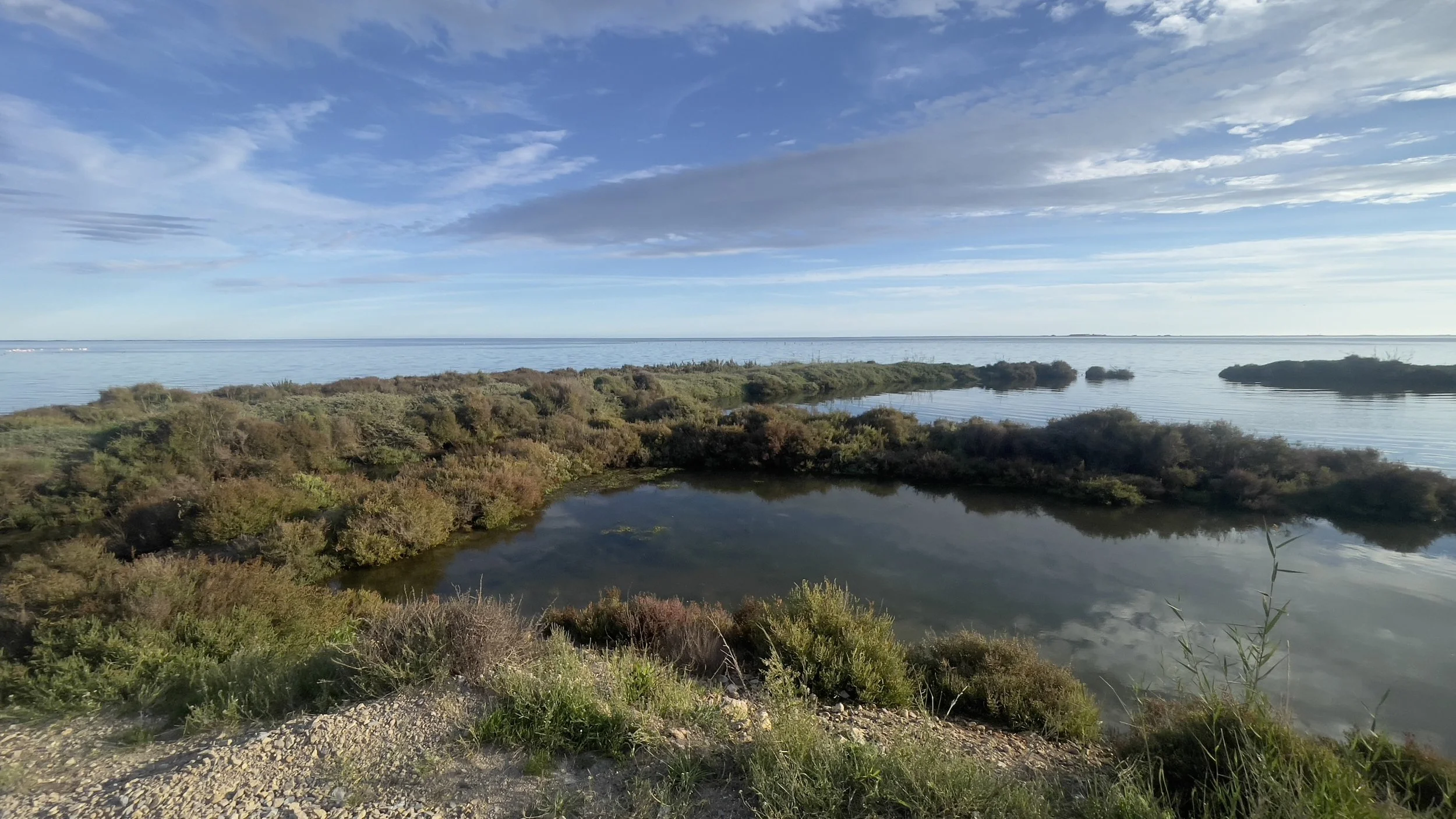
Alfacs bay, Nov 2025
Diatoms, Today
Diatoms are a diverse group of microscopic unicellular algae found in nearly every aquatic environment, including oceans, rivers, lakes, wetlands, and even moist soils. They are known for their intricate silica cell walls, called frustules, which protect them while requiring very little energy to produce, enabling rapid growth compared to many other algae.
Nearly all diatoms are photosynthetic and, despite their microscopic size, make a major contribution to the global carbon and oxygen cycles, fixing around 20% of the planet's annual CO₂ and producing approximately 20% of the oxygen we breathe. As primary producers, they form the foundation of many aquatic food webs and play a crucial role in sustaining life on Earth.
Beyond their protective function, diatom frustules often exhibit geometries optimized to withstand turbulent conditions and mechanical stress. Many benthic and epiphytic diatoms are also capable of limited movement across surfaces. Others regulate their buoyancy by forming chains or producing extracellular substances that allow them to move vertically through the water column in search of nutrients.
Diatoms have evolved a range of unique adaptations that enable them to thrive in highly diverse and often rapidly changing aquatic environments. Unlike terrestrial plants, which rely primarily on red and infrared light for photosynthesis, diatoms have developed highly efficient light-harvesting systems capable of absorbing blue and green wavelengths, which are more abundant in deep waters and at higher latitudes. This adaptation allows them to inhabit temperate and polar aquatic ecosystems.
They are also remarkable for their ability to adapt to transitional and highly variable habitats such as estuaries, brackish waters, and seasonal lagoons, where salinity, temperature, and light conditions can change rapidly. This sensitivity to environmental conditions makes them excellent bioindicators for monitoring water quality, pollution levels, and ecosystem change.
For Sonic Silica, eight species (four as genera) have been selected from the PHYTOENVDELTA dataset. These are among the most representative diatoms recorded in a collection of samples gathered from the Fangar and Alfacs bays of the Ebro Delta between 1990 and 2019:
Genus: Chaetoceros, Pleurosigma, Pseudo-nitzschia, Thalassionema
Species: Cerataulina pelagica, Cylindrotheca closterium, Leptocylindrus danicus, Leptocylindrus minimus
The Ebro Delta, Today
Covering approximately 320 km², the Ebro Delta is one of the largest wetlands in Western Europe and a vital refuge for numerous migratory species. However, it is under increasingly severe environmental pressure. The reduction in fluvial sediment input due to river regulation by dams, rapid coastal erosion (with shoreline retreat reaching up to 6–7 metres per year in some areas), land subsidence (at a rate of approximately 5mm per year), and intensive irrigation are accelerating the delta's retreat, leaving nearly half of its surface already at sea level.
These pressures are compounded by sea-level rise (currently around 2mm per year), increasing Mediterranean Sea temperatures (at a rate of 0.044°C per year), saltwater intrusion, and increasingly intense storms (such as Storm Gloria in 2020). Current projections estimate a sea-level rise of between 0.53 and 0.73 metres by 2100, potentially submerging up to half of the delta.
Diatoms in the Ebro Delta
Catalonia is now considered the "ground zero" of Mediterranean climate change. Extreme droughts (2021–2024), temperature anomalies exceeding +2.7°C above historical averages, and accelerating sea-level rise are profoundly altering the environmental conditions that shape diatom communities:
- Marine heatwaves suppress spring blooms by as much as 70%.
- Critical salinity thresholds (around 5 PSU) are being exceeded, reducing the extent of brackish habitats that sustain diatom diversity.
- Ocean acidification also poses a threat to global diatom populations by affecting the availability of dissolved silica.
- Additional abiotic stressors are affecting the aquatic ecosystems of the Ebro basin, as reflected in biological indices based on diatoms and aquatic invertebrates, particularly as a consequence of increasing phosphorus concentrations.
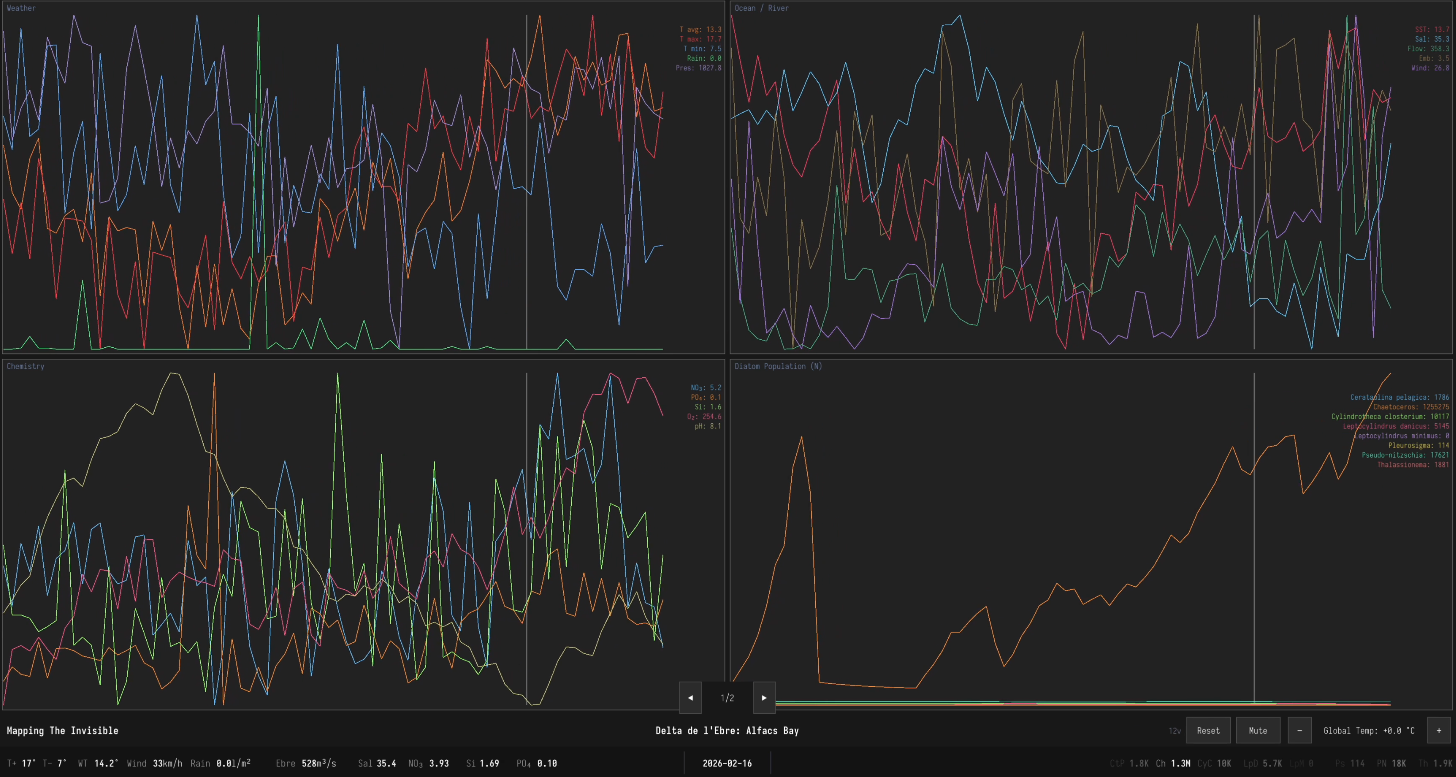
Sonic Silica UI
Sonic Silica
Sonic Silica is a speculative generative sound system based on simulating the lives of diatoms inhabiting the bays of the Ebro Delta and the network of ecological dependencies that shape them, including climate, hydrology, marine chemistry, and population dynamics, in order to reveal the changes these organisms are likely to undergo in the near future.
The combination and analysis of long-term datasets show that diatoms cannot be understood merely as a collection of microscopic species inhabiting the delta, but rather as the visible outcome of a much broader system of environmental relationships. Water temperature, salinity, nutrient availability, solar irradiance, the flow of the Ebro River, and meteorological dynamics do not act on biological communities in isolation. Instead, they collectively define the conditions under which each species can proliferate, persist, or disappear. Diatom populations thus become an interface through which physical, chemical, and biological processes converge.
In its first stage, the engine simulates plausible environmental conditions in the Fangar and Alfacs bays according to the time of year by combining meteorological, hydrological, and oceanographic records with stochastic models calibrated on their historical time series, together with external drivers such as the warming of the Mediterranean Sea. From these conditions, it also estimates the availability of nutrients and other dissolved chemical compounds in the water.
A second model then interprets this environmental state through a set of species-specific population models to calculate the presence of diatoms. This stage also accounts for the possibility that favourable environmental conditions may trigger a bloom, allowing populations to increase by several orders of magnitude.
Once diatom abundance has been calculated, this data is sonified. Each species or genus occupies an independent voice within the system. Population size controls the density of sonic events, relative abundance contributes to the balance of the overall texture, and selected meteorological parameters (wind and rainfall) determine each voice's position within the stereophonic field. The acoustic identity of every voice has been constructed through resynthesis processes inspired by the material properties of diatom silica frustules.
Chaetoceros (Wikipedia)
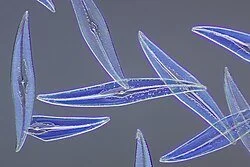
Pleurosigma (Wikipedia)
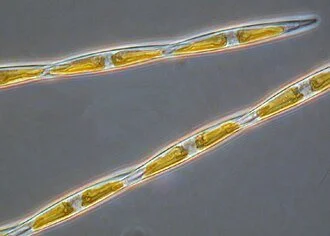
Pseudo-nitzschia (Wikipedia)
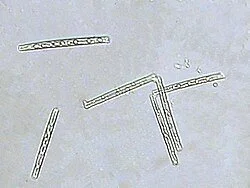
Thalassionema (Wikipedia)